
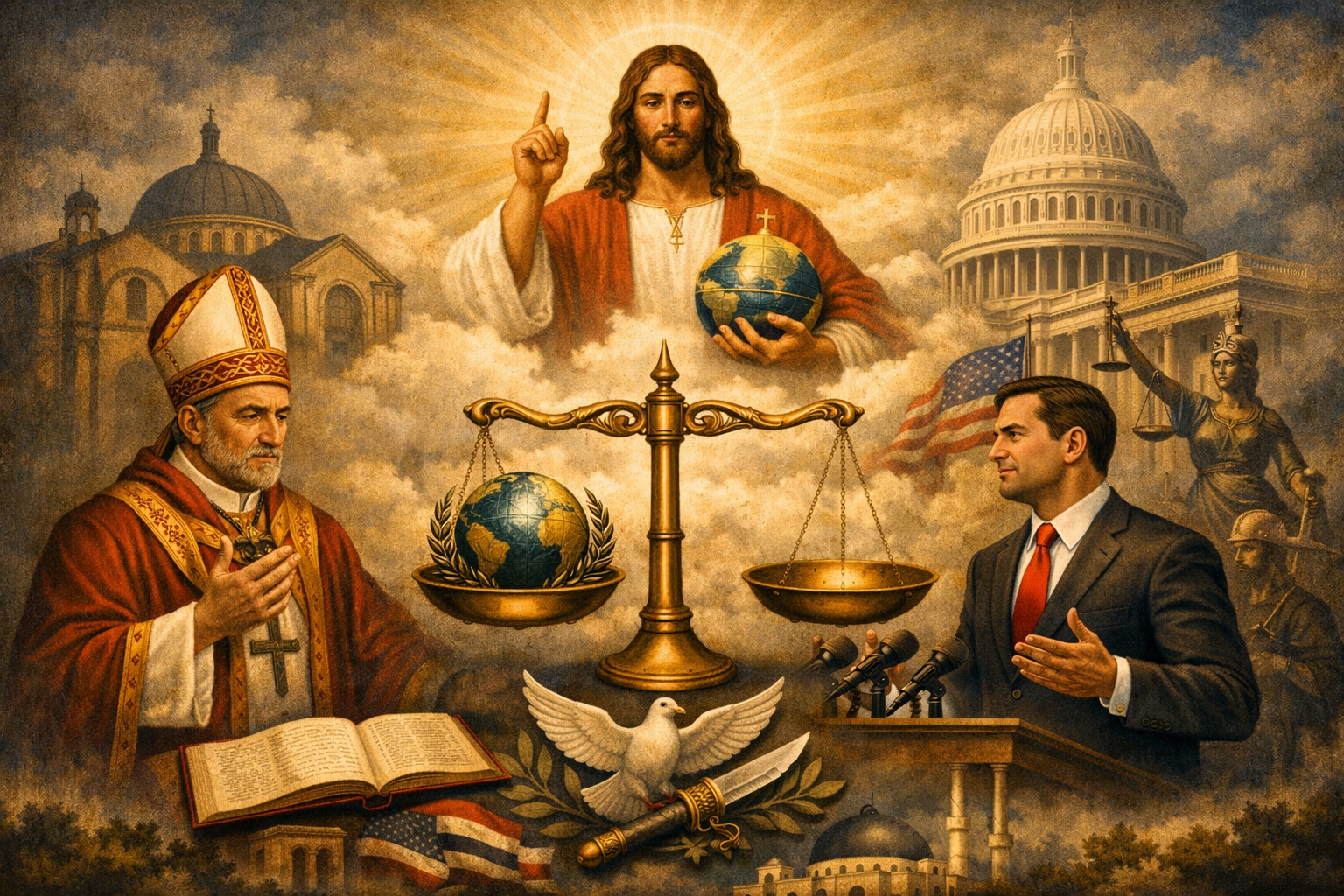

We are living through one of these rare moments, as political, ideological, and civilizational crises converge to bring to the fore three concepts many thought had been consigned to history: sovereignty, power, and religion. Addressing these issues is a necessity imposed by the weight of reality; the profound transformations societies are undergoing today cannot be understood without revisiting the philosophical roots of these concepts and questioning their underlying assumptions.
The Western modernity, in one of its facets, rested on an implicit promise: the separation of the religious from the political, of ecclesiastical authority from temporal sovereignty, of the sacred from the secular. Yet this promise was fulfilled only superficially. While religion was formally excluded from seats of power, it quietly slipped back through the back door into the heart of modern political discourse. Carl Schmitt uncovers this hidden truth when he asserts that the major concepts of modern state theory are, in fact, secularized theological concepts. This observation serves as a crucial analytical key, reshaping our understanding of the relationship between two spheres that were meant to remain forever apart.
Ever since Georg Hegel declared the state to be "God present in the world," and absolute sovereignty the embodiment of universal reason in its highest form, the debate surrounding the nature, origin, and legitimacy of power has never ceased. Where does sovereignty reside? In the will of the individual or in the general will? Is it based on the social contract, on the metaphysical absolute, or on divine law? These questions, which some believed were settled after the French Revolution in favor of liberal rationalism, have returned today with an urgency that brooks no delay.
The collapse of the Soviet Union in 1991 marked what Francis Fukuyama famously called the "end of history," signaling the triumph of the liberal democratic model as the supposed pinnacle of human organization. Yet the events of the three decades that followed have proven that history is far from over, and that this model is not immune to internal fractures.
Many events reveal questions have remained unanswered in the philosophy of political modernity, and confirm that major concepts refuse to settle within the frameworks that have been defined for them. Those events are the global financial crisis of 2008, the rise of right-wing populism in the strongholds of Western democracies, the profound transformations in the Middle East after 2011, and the renewed conflicts extending from Eastern Europe to West Asia.
What is even more significant than political events is the profound anthropological failure caused by modernity’s attempt to construct a secular human model, overflowing with desires and rights, yet devoid of meaning and purpose. Since Friedrich Nietzsche proclaimed the death of God, the question of political legitimacy has floated untethered; for with the death of God, not only does the notion of the sacred vanish, but also every value that drew its certainty from a transcendent reference is shaken. In the void left behind, numerous attempts have emerged to fill the gap: nationalist ideologies, the worship of the state, a religion of progress, and even faith in the market. Yet all these alternatives have proven incapable of supplying what the religious dimension once lent to political life: transcendent legitimacy, sovereignty that surpasses the whims of individuals, and a horizon of meaning that grants political action a dimension beyond immediate calculations of interest.
With the dawn of the third millennium, the phenomenon of religion's return to the public sphere became the focus of extensive studies and analyses. The liberal theorist Jürgen Habermas pointed out that Western societies have entered a "post-secular" phase, where it is no longer acceptable to exclude religious voices from public discourse under secular pretexts. This liberal acknowledgment implicitly recognizes that the project of exclusion was not based on purely philosophical justifications, but rather was the embodiment of a political will cloaked in the language of reason.
In contrast, unlike in the West, religion has never been absent from the public sphere in Muslim-majority societies; rather, it has continuously reinvented itself in new forms, raising pressing questions about the relationship between power, Sharia, and national sovereignty.
The great paradox lies in the fact that Islamic thought faces two simultaneous challenges. The first is external, demanding that it comply with the standards of political modernity, and the second is internal, touching its essence: Does the Islamic political heritage represent a living system capable of interacting with new developments, or has it turned into a mere historical memory lacking the tools for building?
Our research emerges from this multifaceted background, undertaking a dual intellectual project based on critique and foundation. The critique targets the philosophical assumptions of major Western schools of thought in their views of sovereignty, power, and religion, demonstrating how these schools, despite their depth and richness, suffer from a structural deficiency that renders them incomplete models when presented as universal or comprehensive standards.
First: Western Doctrines under Scrutiny
No serious intellectual project can begin in a vacuum, nor can it base its arguments on a preconceived condemnation of the other without a thorough examination of their achievements and an understanding of their arguments from within. Hence, the necessity of critical engagement with major Western schools of thought regarding their views on sovereignty, power, and religion; not to reject them entirely, but to deconstruct their conceptual frameworks and expose their implicit assumptions. True critique is a resumption of dialogue based on knowledge of the other, not ignorance of them.
The modern Western political philosophy began its ambitious project by attempting to separate theology from politics, or at least that is what it claimed. Since Thomas Hobbes developed his theory of sovereignty in the aftermath of the religious wars that tore Europe apart, declaring that the social contract, rather than God or the Church, is the source of political legitimacy, Western political discourse has presented itself as a rational, neutral language, equally distant from all religious doctrines and drawing legitimacy from none of them. Yet this claim carries a profound paradox: the absolute sovereignty of the state that Hobbes outlined in Leviathan is, in its logical structure, no different from the divine sovereignty he sought to surpass, it is absolute, beyond question, and the ultimate source of all law and legitimacy.
When John Locke sought to temper Hobbes’s rigidity and lay the foundations for political liberalism as a system that protects natural rights and restrains authority through popular consent, it seemed that the Western project had taken a qualitative step toward humanizing politics. Yet Locke’s concept of natural rights was not entirely detached from the theological foundation that secular discourse claimed to renounce; he maintained that humans are Allah's creatures and servants, sent into the world by His command and in His service, they belong to Him, not to each other. The natural rights ultimately derive their legitimacy from the Creator, not from abstract reason. Nevertheless, this theological heritage would later be harnessed to construct a secular system that purports to be independent of any religious authority.
Jean-Jacques Rousseau added a new dimension to this trajectory by replacing divine sovereignty and Hobbes's social contract with the concept of the "general will," presenting it as the supreme entity, infallible, to which all individual wills must submit. Many scholars have noted that Rousseau’s general will functions in a quasi-religious manner within his philosophy: it is the absolute source of legitimacy that cannot be questioned, the highest authority from which there is no appeal. In this context, Ernst Cassirer argued that Rousseau did not abolish political theology but reformulated it in humanistic terms, with the nation taking the place of God and the general will supplanting divine revelation.
On a sociological level, Max Weber represented a decisive turning point in understanding the relationship between religion and authority through his distinction among three types of domination: traditional, charismatic, and legal-rational. Weber argued that political modernization inevitably moves toward the third type, and that secularization is the inescapable outcome of a comprehensive rationalization process that gradually removes religion from the public sphere. For decades, this vision became almost doctrinal in Western political sociology, until it confronted realities that refused to follow this linear trajectory.
Michel Foucault profoundly unsettled the foundations of Western thought by demonstrating, through his analysis of power and its sources, which it operates as a network deeply embedded in the fabric of society. In his critique of the classical notion of sovereignty, he urged a departure from viewing power solely as a negative force of repression and concealment, emphasizing instead that it is productive of reality. While Foucault’s perspective opened up a broad critical horizon, it simultaneously created an epistemological dilemma: if power is everywhere and no authority stands above it, by what standard can it be evaluated or resisted. Here, postmodern thought finds itself confronted with a chasm of relativism that is difficult to bridge.
What unites these diverse schools of thought, despite their methodological differences, is their engagement with the problems of sovereignty, power, and religion from within a specifically European civilizational horizon, shaped by the post-Reformation period and the industrial and political revolutions. It is from this context that they derived their concepts and questions. The issue is not that these theories emerged from a particular historical context, that is natural, but that they claim universality: presenting locally conditioned answers as comprehensive human solutions applicable across all times and places, and expecting other civilizations to conform to their standards.
Moreover, these schools share a fundamental anthropological limitation: they begin from a conception of human beings as self-interested creatures, pursuing rights and self-realization, stripped of their spiritual dimension and of belonging to a value system, which transcends the individual and the immediate. When political theory is built on this partial conception of humanity, power becomes deficient, sovereignty fragile, and law hollow of purpose. This is precisely what we aim to reveal that philosophical critique of Western doctrines is a call toward a broader and deeper intellect, an intellect that does not separate human beings from their ultimate purpose, politics from ethics, or authority from meaning.
Second: The Islamic Perspective as Alternative, Critique
If criticism alone is insufficient to construct a coherent intellectual position, then grounding oneself in Islamic thought represents the other essential aspect of any serious philosophical project. By grounding oneself in Islamic thought, we do not mean nostalgia for an idealized past, nor an emotional defense of identity against the other. Rather, we mean the systematic extraction of major Islamic concepts from their historical context and their re-employment as dynamic analytical tools capable of engaging with contemporary questions using their own internal logic. In this context, the Islamic philosophical school possesses a profound body of knowledge accumulated over centuries of inquiry into the issues of existence, humanity, power, and purpose. This body of knowledge reached its zenith in the modern era at the hands of thinkers such as Allamah Sayyid Mohammad Husain Tabatabai and Martyr Murtada Mutahhari, who combined the depth of tradition with an awareness of the present.
Its ontological foundations distinguish this philosophical perspective on the problem of sovereignty and authority. The question of authority is preceded by a deeper inquiry into human nature and its existential purpose, as well as the relationship between the seen and unseen worlds in shaping the social order. Allamah Tabatabai bases his political and social vision on the concept of human nature as the essential starting point for any theory of human society. He argues that humans are inherently social beings, not merely by necessity; that is, their inclination towards society stems from their existential constitution, not from a fleeting need that compels them to enter into contracts with others. Herein lies the fundamental difference between the Islamic philosophical conception and the modern Western perspective. While the social contract, according to Hobbes, Locke, and Rousseau, arises from a hypothetical situation that presupposes the separation and competition of individuals, Tabatabai makes social interaction an existential condition preceding any contract. This imbues authority with an organic, teleological character, rather than a purely contractual or procedural one.
Based on this ontological foundation, the martyr Murtada Mutahhari constructs his theory of justice as the central concept that governs the relationship between sovereignty, authority, and religion. For him, justice is an objective and immutable standard that transcends the will of both ruler and ruled, deriving its legitimacy from the moral structure of existence itself. In Islam, justice is not a conceptual construct shaped by human will, but rather a firmly established truth within the order of creation. Consequently, just authority is in harmony with the movement of existence, while unjust authority is fundamentally opposed to it. This foundation imbues political critique in Shi'a Islamic thought with a philosophical depth that transcends the procedural legitimacy that liberalism accepts. Authority does not derive its legitimacy solely from elections, nor is it brought down by opposition alone; rather, its legitimacy stems from its objective commitment to justice as a universal standard.
In this context, the contribution of Imam Ali Khamenei (may Allah be pleased with him) to the development of the theory of "religious popular sovereignty" stands out as a serious attempt to reconcile the requirements of guardianship (wilayah) with the demands of the popular will within a coherent philosophical framework. The Imam does not see democracy and religion as contradictory, requiring the dominance of one over the other. Rather, he considers them two inseparable dimensions of a single truth. In his view, political legitimacy rests on two inseparable pillars: a divine pillar, represented by adherence to Islamic law (sharia) and allegiance to the guardianship of the Supreme Leader (wilayah), and a popular pillar, represented by the free acceptance of society and its active will in shaping its political life. The Islamic Republic means the people managing their affairs within the framework of Islamic law (sharia), whereby this formula makes power subservient to humanity in its worldly sphere and consistent with its higher aspirations.
This approach is distinguished philosophically by its rejection of the 'theocracy and democracy' dichotomy through which Western discourse confines Islamic political models. Instead, it presents a model that makes popular support a condition for legitimacy, not its antithesis, and religious authority a regulator of power, not a usurper of the will. With this synthesis, contemporary Shi'a political thought transcends the dilemma of choosing between freedom and Sharia, posing a more profound question: How can true freedom be contingent upon adherence to a value system that transcends the fluctuating individual will without negating it?
From this emerges, within Islamic political thought, the profound philosophical problem of wilayah (authority), which goes beyond the traditional frameworks of Islamic political jurisprudence. In the Islamic philosophy, wilayah rests on two interrelated dimensions: a constitutive dimension concerned with the spiritual and intellectual guidance of society toward its existential perfection, and a legislative dimension related to the governance of public affairs and the establishment of justice.
Imam Khomeini reinterpreted this concept in his theory of the "Guardianship of the Jurist" (Wilayat al-Faqih), uniting these two dimensions within the context of the Major Occultation. He argued that a qualified jurist, meeting the necessary conditions, possesses, in principle, the authority of the Prophet and the Imam in managing societal affairs and achieving justice, even if he differs from them in existential rank and infallibility. This theory has sparked extensive philosophical and jurisprudential debate within Shia thought, a debate that underscores the dynamism of this system and its capacity for self-reflection.
Amidst this debate, a fundamental philosophical position emerges that of Sayyid Mohammad Baqir al-Sadr, who chose to base his political theory on the concept of "human stewardship" rather than limiting himself to the concept of "guardianship." He argues that the Quran's emphasis on human stewardship on Earth establishes a comprehensive theory of sovereignty and authority. This theory rests on God's absolute sovereignty on the one hand, and the delegation of authority to humankind as responsible stewards on the other. Thus, Islam does not negate the role of the nation in shaping its political life; rather, it provides it with a solid foundation by making stewardship a collective responsibility, not an individual privilege. With this approach, Islamic theory transcends the dichotomy of theocracy and democracy into which Western discourse confines it, offering a third model in which divine rule does not negate human agency, nor does human agency preclude divine authority.
On the epistemological level specifically, Allamah Tabatabai, in his major commentary and philosophical writings, makes a significant contribution to linking the theories of knowledge and politics. He demonstrates that the crisis of power in Western modernity is fundamentally an epistemological crisis that precedes the political crisis. When human knowledge severed its connection to divine revelation and relied solely on abstract reason, it faced fundamental questions it could not answer: What compels a ruler to be just in the absence of a higher authority than his will? How can the majority be expected to uphold the rights of the minority in the absence of an objective standard preceding voting? When humanity isolates revelation from the realm of knowledge, it does not attain freedom but falls captive to a form of subjugation, the subjugation of desire over reason, and of power over truth. Hence, this philosophical system not only offers an ideological alternative but also presents a comprehensive epistemological project that reformulates the questions before formulating the answers. It does not merely inquire into how power is organized, but also explores the nature of the human being for whom power is organized, the purpose toward which it is directed, and the knowledge that governs it. In this presentation of the philosophical question over the procedural question lies the deeper impact of this heritage in confronting the crises of contemporary political thought.
Third. Comparison, Synthesis
It remains a step after we have reviewed the major Western doctrines in the balance of criticism, and presented the Islamic philosophical perspective as an original alternative and not merely a defensive position. This third step is indispensable in any intellectual project that seeks methodological integrity, which is to monitor the points of contact between the two systems, and to dissect the points of agreement and divergence with a philosophical eye that avoids rushing to condemn or rushing to praise.
The first point that must be acknowledged is that the major challenges occupying modern Western political philosophy are, at their core, common human questions that different civilizations have posed in varying formulations. How can power be exercised without degenerating into tyranny? How can the individual be protected from the tyranny of the collective, and the collective from the disintegration of the individual? How does a legal system derive its legitimacy and bind those who did not consent to its enactment? These questions were already present in Islamic jurisprudence and philosophy long before they were articulated in the language of Western modernity, and their shared nature opens the possibility of genuine dialogue, moving beyond rhetorical debate to collective reflection.
A deeper reflection on this shared intellectual history reveals something even more striking and significant: modern Western political thought has borrowed essential concepts and intellectual structures from the Islamic tradition without acknowledging or naming this debt. The principle of the rule of law, and its supremacy over the will of the ruler, which today underpins political liberalism, was philosophically grounded in Islamic jurisprudence centuries earlier, when the Sharia was positioned as prior to authority and governing over it rather than emanating from it. Similarly, the principles of accountability and the people’s right to question or depose a ruler, often presented as purely Western achievements, find solid roots in Islamic theories of Imamate and Caliphate, where rulers were bound by conditions and the community retained the right to object in case of violation.
This is not, of course, to diminish Western intellectual contributions in developing political theory; rather, it underscores the intertwined and complex history of ideas, which challenges the grand nationalist narratives that each civilization tells about itself. Awareness of this interconnection is essential for genuine critical dialogue: it mitigates civilizational polarization and opens space for collective reflection on fundamental human questions, for which no single civilization can claim exclusive answers. At the same time, critical dialogue requires naming what both models lack, without flattery or evasion. The Western liberal model suffers from a structural anthropological poverty, as noted earlier, it constructs its political system around an individual stripped of purpose, whose rights and ambitions are guaranteed, yet whose existence hangs in a vacuum of meaning. When politics is severed from the human being’s existential purpose, it becomes a technique for managing interests, and freedom shifts from a spiritual value to a commodity distributed by the market. This crisis has been recognized from within Western thought itself, notably by the Canadian philosopher Charles Taylor, who warned that Western political modernity produces a "soft individualism" that strips life of meaning and weakens attachment to any horizon of significance beyond the self and its desires.
The Islamic model, for its part, is not without genuine challenges requiring candid acknowledgment. Despite the richness of its foundational philosophical concepts, historical applications of these ideas have often fallen short of their philosophical potential. Institutionalization, how concepts are translated into mechanisms, procedures, and guarantees, remains one of the areas most burdened by the lack of practical solutions. Claiming that authority is constrained by Sharia remains incomplete unless concrete institutional mechanisms exist to translate this constraint into reality, preventing tyranny in the name of religion.
What both models lack, perhaps most tellingly, is the capacity to conceive politics from the perspective of the complete human being rather than a fragmented image. The Western model takes the economic or rights-bearing individual as its sole entry point into political theory, while the classical Islamic jurisprudential model sometimes limits itself to the dutiful, rule-abiding individual. Yet the real human being is an existential entity seeking, simultaneously, security, dignity, belonging, meaning, and transcendence. Any political theory that fails to accommodate this anthropological richness will remain inadequate, no matter how precise its principles or mechanisms. It is precisely here that the horizon of this research can be drawn: a framework for political thought that begins with the full spectrum of human dimensions, spiritual, intellectual, and social, and positions authority as a servant of this complete human being rather than as a custodian of only some of their aspects.
Fourth: Horizon of Civilizational Alternative
If philosophy at its highest reaches aims to generate questions
that shake false certainties and open up unseen possibilities, this
study follows a similar path. Our goal has not been to provide
definitive answers to issues that have puzzled humanity for centuries, but rather to revisit fundamental questions, unpack the assumptions behind ready-made answers, and create a space for shared reflection that moves beyond the rigid binaries of the so-called "civilizational Cold War" still dominating contemporary debates on sovereignty, power, and religion.
From this introduction, it becomes clear that the crisis affecting the modern political system, whether in its Western context or in those claiming inspiration from Islamic heritage, is fundamentally philosophical. It concerns our vision of humanity and the purpose of political community. Until this crisis is addressed at its philosophical roots, technical solutions will remain mere treatments of symptoms, leaving the underlying malady intact. We must remember that political systems embody philosophical visions of human nature and the common good; thus, any systemic crisis is, at its core, a crisis of the philosophy on which it rests.
From this perspective, we can define the civilizational alternative we advocate more precisely. It is not a call to revive a specific historical model, such as the caliphate in its classical form or the religious state in its literal sense. Nor is it an attempt to replicate the Western liberal model and embellish it with Quranic verses and Islamic terminology. The alternative we envision is a distinct intellectual project, one that draws upon the depths of Islamic philosophical heritage, with its vision of humanity, existence, and purpose, to produce new concepts that address contemporary issues. What can be described as philosophical, not just jurisprudential, endeavor is the reactivation of the intellectual energies of the heritage to confront questions that classical jurists were not familiar with in their current form.
This project demands a rare, dual form of courage: the courage to critique one’s own heritage from within without severing ties to it, and the courage to learn from others without losing one’s identity. Internal critique of the tradition is a methodological necessity; the creative potential of a heritage cannot be revived without unpacking the narrow interpretations and authoritarian appropriations that have, over time, diminished its emancipatory dimension. As the martyr al-Sadr emphasized, one must distinguish between what is essentially Islamic and what is merely historical in its formation. A Muslim thinker does not sanctify Islamic history but rather sanctifies Islam itself. This distinction should not be blurred through leniency toward criticism, nor by the illusion that everything in our historical record faithfully reflects the essence of Islam. Conversely, drawing on the shared human experience, including Western achievements in institution-building and the establishment of rights protections, does not imply intellectual subservience. It signifies awareness that humanity accumulates experiences and learns from them. Yet, this engagement is conditioned by a crucial principle: it must originate from within, not from outside.
The Muslim thinker approaches Western experiences with questions grounded in his own context, seeking tools to address his specific challenges, rather than accepting ready-made solutions for problems he did not formulate. There is a fundamental difference between reading Immanuel Kant, Georg Hegel, or John Rawls through lenses shaped by Tabatabai, Motahhari, and al-Sadr, and reading Islamic heritage through lenses saturated with Kant, Hegel, and Rawls.
The most pressing question at the end of this journey remains: Who will undertake this project and bring it to fruition? The civilizational alternative is patiently, and deliberately, taking shape at research tables, in university halls, and on the pages of reputable intellectual journals that possess the courage to pose fundamental questions. This project represents a generation of thinkers who combine a deep understanding of the Islamic philosophical heritage with a keen awareness of the challenges of the age. They do not rush to find answers, nor do they shy away from asking questions. We do not claim to have completed this project, but rather to be a step in its path; a step towards an Islamic political philosophy that thinks with its own tools about the issues of our time, without regressing to a past that cannot be retrieved, and without dissolving into the paths of others.
For a civilization, that does not derive its political philosophy from its own spiritual and intellectual depth will remain a consumer of others' ideas, and will be governed by concepts it did not create to solve problems it did not pose. Herein lies the deepest wager of every serious intellectual effort in our Arab and Islamic world today: that we move from the role of recipient to the role of maker of concepts, and that we become active partners in the human dialogue about sovereignty, power and religion, not just a subject that others discuss and debate.
In any case, as part of deepening this inquiry and advancing this line of thought, this issue of "Eitiqad" magazine seeks to open a space for dialogue on these pressing questions. The studies it presents revolve around the following themes:
A select group of professors and researchers addressed different aspects of sovereignty and authority in religious thought and philosophy in the "Focus" section. They are: -Prof. Sayyed Hafez Abdel Hameed (Egypt) in his research entitled: "State, Source of Legitimacy in Religious Thought, Modern Philosophy".
-Prof. Ghaidan el-Sayyed Ali (Egypt) in his research: "Deconstructing the Political Body: Critique of Sovereignty in Foucault, Agamben".
-Dr. Nariman Amer (Syria) in her research: "Transformations of
Concept of Sovereignty in Western Thought (Carl Schmitt as Model)".
-Mr. Shadi Ali (Egypt) in his research: "Sovereignty, Justice in Shiite Philosophy: Reading in Thought of Allamah Tabatabai, Martyr Motahhari".
-Sheikh Hussein Mahmoud Kawtharani (Lebanon) in his research: "Religious Popular Sovereignty in Thought of Imam Khamenei (may Allah have mercy on him)."
In the "Studies and Research" section, we have selected a study
prepared by the editor-in-chief, Dr. Mohammad Mahmoud
Murtada, entitled "Legislative Authority of the Infallible."
As for the "Book Review" section, we have chosen the book "Awakening Nation, Purifying Faith," reviewed by the translator Lina al-Saqr (Syria).
In presenting this issue, we hope it will meet with the readers' approval, and we kindly ask them to share their valuable notes.
Praise be to Allah, the First and the Last.
Editor-in-Chief
References and Sources
1. Ernst Cassirer: The Philosophy of the Enlightenment, translated by Ibrahim Abu Hashhash, Arab Center for Research and Policy Studies, Beirut, 1st edition, 2020.
2. Charles Taylor: The Crisis of Modernity, translated by Mohamed Mahjoub, Dar Sinatra, Tunis, 1st edition, 2011.
3. Thomas Hobbes: Leviathan, translated by Diana Habib Masoud, Dar Al-Farabi, Beirut, 1st edition, 2011.
4. Georg Wilhelm Friedrich Hegel: Elements of the Philosophy of Right, translated by Imam Abdel Fattah Imam, Dar Al-Tanweer, Beirut, 2nd edition, 2010.
5. John Locke: A Treatise of Government, translated by Majed Fakhry, Arab Organization for Translation, Beirut, 2nd edition, 1991.
6. Ruhollah Khomeini: Guardianship of the Jurist, Islamic Government, Institute for the Compilation and Publication of Imam Khomeini's Works, Tehran, 4th edition, 1996.
7. Francis Fukuyama: The End of History The Last Man, translated by Hussein Ahmed Amin, Al-Ahram Center, Cairo, 1st edition, 1993.
8. Friedrich Nietzsche: The Gay Science, translated by Hassan Bourqia, Africa East, 1st edition, 1993.
9. Carl Schmitt: Political Theology, translated by Rania Al-Sahli, Arab Center for Research and Policy Studies, 2nd edition, 2024.
10. Max Weber: Economy and Society, translated by Mohammad Sayyed Ghanem, Madbouli Library, Cairo, 1st edition, 2004.
11. Muhammad Baqir al-Sadr: Islam Leads Life, Dar al-Ta'aruf for Publications, Beirut, 2nd edition, 1979.
12. Mohammad Hussein al-Tabatabai: The Balance in the Interpretation of the Qur'an, Al-A'lami Foundation for Publications, Beirut, 2nd edition, 1997.
13. Murtada Mutahhari: Divine Justice, Dar al-Ta'aruf for Publications, Beirut, 3rd edition, 1995.
14. Michel Foucault: Discipline and Punish: The Birth of the Prison, translated by Ali Muqallad, National Development Center, Beirut, 1st ed., 1990.
15. Jürgen Habermas: Religion and Rationality, translated by Najib al-Hassadi, Africa al-Sharq, Morocco, 1st ed., 2007.


Comments