
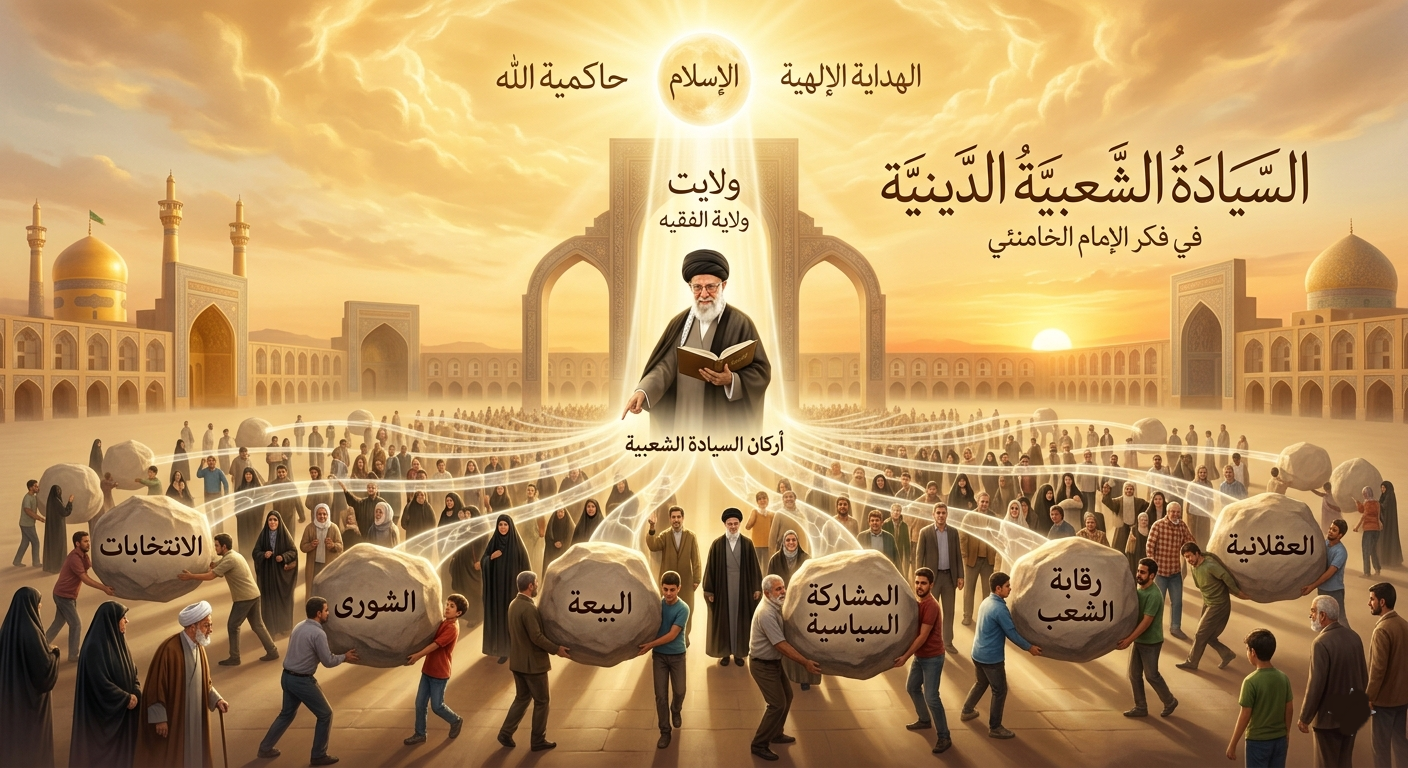
It proceeds from the premise that Islam constitutes a comprehensive system capable of regulating both political and social life, concluding that the very success of the Islamic model is what drives its adversaries to attempt to distort it. The study also elucidates the genesis of this term, tracing its inspiration to the experience of the Islamic Republic of Iran; it notes that this concept is not distinct from that experience, but rather serves as its embodiment and articulation.
The theory rests upon three fundamental pillars: Allah’s absolute sovereignty; the role of the people in selecting officials and consolidating the political order through elections; and "Wilayat al-Faqih" (Guardianship of the Jurist) as an executive mechanism for preserving Sharia and managing state affairs during the era of Occultation. Furthermore, the study undertakes a critical comparison with Western democracy, arguing that the latter is grounded in moral relativism and is subject to the dominance of wealth, media, and external interference; conversely, the Islamic model links freedom to moral obligation, immutable values, justice, independence, and the defense of the oppressed. The study concludes that this model offers a contemporary political and ethical alternative characterized by a distinct civilizational dimension.


Comments