
In this sense, woman becomes a clear mirror reflecting the depth of a civilization’s vision of existence and revealing the fundamental principles that shape its understanding of the self, the body, and value. It is from this premise that we proceed, taking the question of femininity as an entry point for examining two major systems that compete to shape the consciousness of contemporary humanity: a Western system that has elevated freedom to a quasi-theological status, and an Islamic system that places human dignity at the foundation of human existence as a whole.
The "theology of femininity" expresses a deep tension at the heart of modern culture. Freedom and dignity are two terms that recur throughout contemporary discussions of women, yet each rests on a fundamentally different metaphysical foundation. When freedom is treated as an absolute principle, the human being is understood as the creator of the self, capable of constructing its own identity and defining its essence without reference to any pre-existing model. When dignity is regarded as a foundational principle, by contrast, the human being is understood as dignified by virtue of creation itself, possessing an inherent value that precedes every action and every achievement. From these two foundations emerge two different conceptions of femininity: one arising from a will that creates itself within a world stripped of predetermined meaning, and another unfolding from a dignity embedded in the human self from the very beginning of its existence.
A sound examination of this issue requires an approach that understands manifestations in light of their underlying foundations. Attitudes toward women and the body are not isolated phenomena; they are products of deep metaphysical roots. Focusing only on their outward manifestations therefore leaves the analysis at the surface level. Our approach here is consequently to return to first principles. We trace the conception of femininity in Western thought back to its sources in philosophical modernity, and set against it the Islamic perspective as it emerges from its foundations in transcendent wisdom. Through this foundational approach, the dialogue between the two systems becomes a dialogue between two metaphysical frameworks and between two different sets of first principles, rather than merely a comparison of isolated rulings and surface-level positions.
In this time, the question of femininity carries a cultural and civilizational significance that extends beyond intellectual debate into the broader struggle over consciousness and meaning. The image of woman has become a point of confrontation between two different visions of the human being and existence, as well as a field in which the struggle over meaning is waged through culture, media, and symbols. Western ideas about femininity and the body are increasingly transmitted into Arab and Islamic consciousness through a powerful flow of images and discourses. In the process, they gradually reshape underlying perceptions from within, often in ways that remain unnoticed by many of those who encounter them.
First: Emergence of "Femininity" as Concept in Western Consciousness
Understanding Western representations of femininity begins with recognizing the foundational moment in which the modern conception of nature and the body emerged. Philosophical modernity developed as a project aimed at controlling the world and was grounded in a view of knowledge as a means of power, domination, and exploitation. Francis Bacon famously declared that "knowledge is power" and shaped modern science around the idea of questioning nature and forcibly uncovering its secrets. Within this foundational discourse, nature was represented as feminine: something to be questioned, controlled, and disciplined. From the beginning, therefore, femininity became associated with the position of matter that is subject to shaping, manipulation, and control.
This scientific transformation was preceded by a transformation in the way nature itself was understood. In the ancient view, nature was understood as an ordered and created system that possessed purpose and meaning and was filled with mysteries and symbolic significance. In modernity, however, nature was transformed into silent matter governed by the laws of movement and quantity, emptied of inherent purpose and meaning, and made available for measurement and exploitation. As the sacred gradually withdrew from the world, the universe came to be understood as a vast machine governed from outside itself. Within this new framework, femininity, through its association with nature and the body, was placed in the position of matter that is managed and controlled. It consequently came to be understood as an object subjected to the authority of the knowing and controlling subject.
René Descartes then reinforced the separation between two fundamentally different substances: the rational mind, which was regarded as the basis of authentic existence, and the extended body, which functioned like a machine. Within this dualistic framework, the body became a silent extension governed by the laws of mechanics and sharply separated from its symbolic and existential meaning. Once the body was reduced to the status of a machine, women, whose image had been closely associated with the body, were likewise placed within this same category. As a result, in modern metaphysics, woman came to be understood as matter that is managed and controlled from outside itself. This division produced an image of the modern self based on the centrality of the thinking mind. The knowing subject became the source of certainty and meaning, in contrast to a world of extended objects that remained subject to its observation and control. Within this cultural framework, masculinity came to represent the active mind and the knowing subject, while femininity was placed within the categories of nature, the body, and the passive object. This division established a hierarchy of values that placed reason above the body and the active above the passive, assigning femininity to a lower position. Out of this classification, a discourse of liberation later emerged, calling for women to occupy the position of the active subject. However, this discourse remained tied to the metaphysical framework that linked value to reason, will, and control.
Through this dual foundation, represented by Bacon's science of control and Descartes' dualism of substance, the ground was prepared for the emergence of the concept of “femininity” in Western consciousness. Femininity came to be understood as a nature to be disciplined and a body to be managed. This opened the way for a long historical process in which women were gradually transformed from beings with existential meaning into objects that could be shaped according to the will of the active subject. This metaphysical foundation provides a key to understanding later transformations in Western thought concerning women and the body.
Secondly: From the Body (as Machine) to the Body (as Project)
Western thought gradually moved from viewing the body as a machine governed by the laws of nature to viewing it as an open project subject to the will of its owner. This shift was developed through existentialist philosophy and then postmodernism. By the end of this development, the body had become a space in which absolute freedom could be exercised in the making of the self.
This transformation was prepared by the growing importance of the body and desire in the understanding of the human being. Sigmund Freud (1856–1939) made sexual desire a hidden driving force of the psyche and a source of human actions. The body therefore became the site of the unconscious and the stage on which its conflicts were played out. Jacques Lacan (1901–1981) continued in this direction by understanding desire as a symbolic structure formed within language and absence. As a result, the body moved to the center of discussions about the self, while femininity became a field shaped by competing interpretations of desire, language, and power. Simone de Beauvoir (1908–1986) established an important foundation for this transformation by presenting femininity as a cultural process acquired through education, history, and social conventions. For her, woman is the product of a social formation that is constructed rather than simply given. Femininity was therefore opened to the possibilities of construction and choice after having been understood as something rooted in nature. From this starting point, later theories gained the confidence to separate the meaning of femininity from any prior condition that exists independently of human action.
Michel Foucault (1926–1984) then presented the body as a site where networks of power, discipline, and discourse operate. For Foucault, the body reflects relations of power that penetrate it, produce it, and continually redefine its boundaries. A fixed concept of nature consequently gave way to the changing processes of history, practices, and knowledge. On this basis, Judith Butler developed her theory of gender performativity. She understood sexual identity as something performed and repeated until it becomes established as a seemingly fixed essence. The gender, in her view, is therefore a continuous performance produced through language and action. The body thus reached the highest point of its transformation into an open project, constantly available for interpretation and reconstruction.
This process contains a deep paradox at its core. The self that sought freedom from any fixed natural origin found itself constructed by the very forces it claimed to control. Culture constructed it in Beauvoir’s account, power produced it in Foucault’s analysis, and language performed it in Butler’s theory. The more deeply the project of self-construction was pursued, the more deeply the self became absorbed into the network of relations and discourses that shaped it from outside. Within this perspective, femininity became a shifting position contested by different forces and permanently open to reconstruction, without settling on a stable truth. In this outcome, the philosophy of self-construction reveals its internal limit: freedom based entirely on becoming can leave the individual in a permanent search for an identity whose form changes from one moment to another.
In this process, the body became the primary material from which the will creates the self. It became the field of absolute freedom in determining identity and a site of continuous choice through which the human being regains the power to create the self. With this transformation, the body completed its transition into a field of experimentation and construction, opening the way for a theology of freedom that places human will in the position of the founding principle.
Third: Freedom's Theology, Will as Foundational Principle
The Western manifestations of femininity reveal a hidden theological origin governing them from the depths. In modern Western consciousness, freedom has ascended to a status akin to the sacred, with the human will occupying the position once held by Absolute Being in earlier systems. This elevation is what may be termed a "theology of freedom," wherein freedom has become a supreme value against which all other values are measured and from which all meanings are derived.
Friedrich Nietzsche (1844 - 1900) paved the way for this theology by proclaiming the eclipse of transcendent foundations and advocating for the "will to power" as the basis of value. For him, the human being became the legislator of values, the creator of standards, and the bearer of the burden of creation following the withdrawal of the Absolute from the horizon of meaning. From this proclamation, subsequent thought derived its conception of the self as a foundational authority that fashions its own essence within a space open to infinite possibility.
The meaning of "theology" in this context becomes evident through the sacred status freedom has attained. In this position, freedom acquired an immunity akin to that of the sacred, to the point where questioning it became tantamount to transgressing an immutable principle. Through this elevation, freedom transformed from merely one value among many into a foundational principle that takes precedence over all others, shifting from a means to an ultimate end sought for its own sake. At the heart of this transformation lies the essence of the "theology of freedom": the relocation of the throne from Absolute Being to the human will, and the installation of the self in the very place once occupied by the Sacred in earlier systems.
In this theology, freedom came to be defined as the will’s absolute independence from any pre-existing datum. The self became its own legislator, determining its own essence within a space devoid of any predetermined forms or inherited teleology.
The sanctification of independence reached its zenith in Enlightenment philosophy. Immanuel Kant (1724 - 1804) established autonomy as the foundation of moral dignity, positing that the free will legislates its own moral law. For Kant, dignity became the fruit of rational independence and the yardstick for moral action; thus, freedom was established as the source from which value itself emanates.
This theological principle had a direct impact on the conception of womanhood. In this context, woman has become a free will that defines its own essence, independent of any innate or teleological givens; her body has become a canvas upon which this will exercises its power of shaping and transformation. Freedom here signifies liberation from all pre-existing images and predetermined purposes, opening the way for a self-directed, ever-renewing construction of identity.
This theology rests upon a profound paradox embedded in its very structure: the will, having established itself as an absolute principle, found itself suspended in a void of meaning. The more freedom was exalted within this theology, the more it was deprived of the dignity that grants it meaning and anchors its purpose. In this paradox lies the key to understanding the ultimate fate of the "liberated body" within the Western experience.
Fourth: Outcomes of the Liberated Body
The freedom reveals its true nature through its consequences. When it becomes detached from the ground of metaphysical dignity, it leads the body along paths that reveal its inner limits. Examining the contemporary Western experience, one finds that the liberated body has arrived at three interconnected outcomes. These outcomes all point to a crisis rooted in the very foundations of the concept, preceding the details of its practical expressions:
1- The first outcome: The transformation of the body into a commodity in the market of images. The freedom that turned the body into an open project ultimately surrendered it to the logic of the market and the equations of profit. Thus, the body became a form of capital to be displayed and consumed, and an image circulated within the spaces of advertising and spectacle. In this market, femininity acquired a value measured by the extent of its presence within the sphere of desire and consumption. As a result, woman moved from being a subject who carries meaning to becoming an object presented for observation.
2- The second outcome: The separation of pleasure from meaning.
The body that has been liberated from its existential purpose has become a center of pleasure sought for its own sake, detached from the symbolic horizon that gives it fullness and significance. The relationship with the body has been transformed into a continuous consumption of temporary gratification, while the self remains trapped in an endless cycle between desire and satisfaction, a cycle that reproduces its own emptiness. Within this cycle, the loneliness of freedom becomes evident when it lacks the meaning in which the heart finds rest.
3- The third outcome: The decline of the sacred dimension of the body. Within systems that carry meaning, the body is a sign of divine indication and a place of mystery. In the liberated Western experience, however, it has become material available for manipulation and reshaping according to desire. The symbolic aura of the body has disappeared, and its presence has become merely physical, subject to calculations of utility and pleasure. With the decline of the sacred dimension of the body, the dignity that was once invested in it has also diminished. Freedom alone has remained to govern its destiny, in the absence of the foundation that grants it value.
These three outcomes converge within a single cycle enclosed by the logic of the market. The body, which transformed into a commodity whose image is managed within the economy of desire; and the desire that severed from its original meaning to become a driving force for consumption; and the sacred, receding to make way for utilitarian calculations: all these converge in a single moment, the surrender of femininity to the machinery of the image, a mechanism that does not merely represent the body but actively reshapes consciousness through it. The image of woman within this economy becomes a tool employed in producing desire and directing behavior. Thus, the claimed freedom transforms into a deeper submission to the logic of domination from which modernity originally sought liberation.
These outcomes converge on one fundamental truth: when freedom is built upon itself without metaphysical dignity, it leads the body to the status of a commodity. This outcome emerges from the very core of the Western foundation of femininity. For the will that sought liberation from every transcendent foundation found itself captive to the market and the equations of consumption. Within this horizon, the need becomes apparent for another foundation, one that establishes femininity upon a ground of meaning. This is what transcendent wisdom offers through its metaphysics of the human being.
Fifth: Transcendent Wisdom, Metaphysics of the Human Being
The Islamic perspective on femininity rests upon a solid metaphysical foundation established by the school of Transcendent Theosophy. This school is built upon major principles that reconstructed the conceptualization of existence, the soul, and the body, offering a vision of the human being that combines the stability of the fundamental origin with the openness of the developmental path:
1- The first principle of this school is the authenticity of existence. For Sadr al-Muta’allihin, existence is the concrete, realized reality, whereas essences are conceptual constructs derived by the intellect from the various ranks and degrees of existence. Built upon this principle is the concept of the gradation of existence, the idea that existence is a single reality possessing ranks that vary in intensity and weakness, ascending continuously from the lowest to the highest levels. Through this conception, the entirety of existence becomes a continuous ladder of perfection, with every existent entity occupying a specific place on this ladder determined by the breadth and intensity of its existence.
2- The second principle is substantial movement. According to Sadr al-Muta’allihin, substance is in a state of constant renewal and continuous flux toward perfection; the entire universe is engaged in an existential journey of ascent, moving from potentiality to actuality. This movement yields a conception of the soul that unites the body and the spirit into a single, evolving reality. The human soul originates materially yet endures spiritually; it emerges within the realm of the body and subsequently ascends through stages of immateriality until it reaches its highest stations. Through this principle, the soul and body are united in a single trajectory of ascent, whereby the body becomes a level of the soul and a manifestation of its ascending essence.
From the authenticity of existence emerges a conception of value that anchors it firmly within the existential reality of the being. In this school of thought, value corresponds to the breadth and intensity of existence, rising in tandem with the being’s ascent through the ranks of perfection. Consequently, the human being possesses a value embedded in the very essence of their existence, prior to their actions or achievements, and rooted in their specific station on the ladder of being. In this framework, dignity becomes an objective existential reality, inseparable from the human being just as existence is inseparable from the existent, giving rise to moral and axiological concepts much as a branch springs from its root. By linking existence and value in this manner, Transcendent Wisdom establishes dignity upon a robust metaphysical foundation that safeguards it against fluctuation and change.
The unity of the soul, maintained amidst the multiplicity of its levels, gives rise to a conception of the body that renders it a bearer of meaning at the very core of its constitution. In this school of thought, the body represents a lower stratum of the unitary soul, connected to it much like a shadow is to its source or a manifestation to its underlying reality. The soul permeates the body just as meaning permeates form; thus, the body becomes an articulation of the soul’s reality and an expression of its station on the ladder of existence. Through this connection, the body regains its dignity as the manifestation of an ascending spiritual reality and as the bearer of the trace of the Divine Breath from the moment of creation.
The transcendental Wisdom extends this affirmation of bodily dignity into the realm of the Hereafter. The soul, having originated within the bodily realm and ascended through the ranks of existence, maintains its bond with the body in the subsequent realm of being; bodily resurrection entails the human being’s return with their body in a manner befitting that eternal state. By virtue of this principle, the body rises to a station transcending the confines of earthly life, becoming the bearer of an enduring dignity. These principles complete the conception of the human being as a creature ascending in existence, possessing a dignity that spans from the initial realm of creation to the Hereafter.
These metaphysical principles converge with the concept of the "fitra" (innate human nature) established by Divine Revelation. The Fitra is a divine imprint upon which humanity was created, a steadfast foundation embodying the soul’s inherent capacity for perfection and for the knowledge of its Creator. Substantial movement proceeds toward this primordial origin, bringing the soul to the realization of its innate perfections; thus, the human journey toward perfection becomes the actualization of the potentiality deposited within one’s primordial nature. In this conception, femininity embodies a distinct innate nature, or the "fitra", manifesting specific existential perfections associated with mercy, tenderness, fertility, and beauty. These perfections become manifestations of the Divine Names within the realm of femininity, allowing one’s perspective to ascend from the level of sensory description to the level of the existential meaning to which they point.
Through this framework, the transcendent wisdom offers a human metaphysics that grounds dignity in the very core of existence and frames freedom as an upward movement toward the perfection inherent in one’s origin. It is upon this solid foundation that the Islamic vision of femininity rests, according it a status befitting its true existential reality.
Sixth: Femininity within the Horizon of Honor
In the Islamic worldview, femininity blossoms from the inherent dignity implanted in the human being. Divine honoring encompasses all the children of Adam by virtue of their very creation, establishing dignity as an existential reality that precedes the distinctions of male and female, and indeed, all subsequent differentiations. The Truth, Exalted is He, declares: {And We have certainly honored the children of Adam} [Al-Isra, verse: 70]. Through this all-encompassing honor, femininity derives its value from the essence of honored humanity and assumes its rightful place on the existential ladder ascending toward perfection.
In the light of transcendent wisdom, femininity reveals itself as a mode of the soul’s essential journey toward perfection. The feminine soul is an existential reality that unites body and spirit in a singular path of ascent; its physical form embodies a significance linked to the soul’s connection with its higher realms. Within this perspective, the female body stands as a wondrous sign of creation and a manifestation of Divine Wisdom, bearing the secret of life and testifying to the magnificence of the Creator’s artistry in its most sublime expression. Describing the marvel of creation across its formative stages, the Truth Allah, Almighty, says: {So blessed is Allah, the best of creators} [Al-Mu'minun, verse: 14].
The feminine identity, in the tradition of wisdom and spiritual knowledge, signifies a manifestation of divine beauty. The beauty is one of the attributes of the Divine, and it is manifested at different levels of creation. Femininity is among the most beautiful forms through which this beauty becomes manifest. From this perspective, woman becomes a sign pointing to the beauty of her Creator and a mirror reflecting the effects of His Divine Names. Thus, the perception of her rises from the level of sensory experience to the level of reflection and meaning. Through this elevation, the body is freed from confinement within its physical appearance and becomes a gateway to meaning and a passage toward contemplating the manifestations of wisdom in existence.
Within this perspective, femininity and masculinity complement one another as two modes of human existence. Each represents a distinct level that possesses particular forms of perfection, which complete those of the other, while both meet within the unity of the encompassing human reality. Marriage, according to this understanding, is founded upon this existential complementarity. It becomes a state in which mercy, affection, and tranquility come together, and a horizon in which the perfections of two souls are realized through a shared path of spiritual growth. From this union emerges the family as a space for preserving meaning, nurturing the self, and extending life within a framework of human dignity. Through this complementarity, femininity occupies its place within an integrated existential order that preserves the perfection and meaning proper to each level of existence.
The femininity reaches the highest expression of its meaning in motherhood. Motherhood is a manifestation of existential fertility through which woman participates in the act of creation by the permission of her Creator, carrying life from one stage to another along an ascending path toward perfection. In this context, the female body acquires a heightened dignity, as it becomes the locus of one of the greatest signs of creation and the cradle of human life in its earliest beginnings. In this sense, femininity is connected to the deepest mysteries of existence and the highest levels of creation.
The chastity and modesty, within this perspective, preserve the dignity and meaning of the body. In the Islamic worldview, modesty is an existential state that protects the mystery of the body and preserves its symbolic aura, keeping it within the realm of sign and meaning rather than reducing it to an object of display and consumption. The chastity becomes a positive stance that safeguards the dignity of the body, affirms its connection to its sacred origin, and transforms modesty into an act of preserving meaning in the face of the logic of appearance. The chastity arises from the soul’s awareness of its existential reality and thus becomes an expression of inner freedom that preserves the self within the realm of dignity and establishes one’s relationship with the body on the basis of meaning and reflection.
The freedom, in this context, carries a meaning appropriate to human dignity. For the sages, freedom means liberation toward perfection, an ascent through the levels of existence, and the soul’s movement from its lower states toward its higher ones along the path of servitude to Allah, which is itself the essence of true freedom. According to this understanding, woman is free to the extent that she realizes her existential perfections, ascending through her inward journey toward the ultimate purpose embedded in the very origin of her creation. The freedom here emerges from dignity and ultimately returns to it, becoming a movement toward the perfection for which the soul has been endowed.
Seventh: Integration of Freedom, Dignity within Unified Horizon
In the Islamic worldview, freedom and dignity converge like a root and its fruit. Dignity provides freedom with its metaphysical foundation and ultimate purpose, while freedom realizes dignity along the soul's ascending path toward perfection. Through this integration, the tension between freedom and dignity is resolved, revealing them as two facets of a single reality within the metaphysics of existence.
This integration unveils a conception of freedom that transcends mere absolute independence. In the realm of wisdom, true freedom is the soul’s liberation from the captivity of lower forces and its ascent to the station of perfection for which it was innately created. The soul attains freedom when it realizes its true existential nature and ascends through the ranks of proximity to its First Principle; thus, freedom becomes the very essence of pure servitude, a state through which the human being is liberated from every bond save for the connection to the Creator. Within this framework, a woman is free in proportion to her ascent up the ladder of perfection; she possesses inherent dignity by virtue of her very existence, and she bears a body that bears witness to her spiritual essence.
This integration illuminates the fundamental distinction between the two systems. The Western system established freedom as an absolute principle, ultimately reducing the body to the status of a commodity; conversely, the Islamic system established dignity as a foundation, elevating freedom to the realm of perfection. The distinction between these two paths lies in the foundational principle, a matter that precedes the details of specific rulings, for the principle from which a vision springs determines its ultimate trajectory and defines its horizons. It is within this foundational distinction that the essence of the contrast drawn in this issue, between the theology of freedom and the metaphysics of dignity, resides. This synthesis opens a new horizon for reconstructing the question of womanhood upon a foundation of meaning.
A vision that unites freedom and dignity into a single reality offers woman an image befitting her existential truth: that of a self honored in its origin, free in its journey toward perfection, and bearing a body that is at once a sign, a bearer of meaning, and a vessel of mystery. Through this image, womanhood reclaims its rightful place within the metaphysics of existence, ascending from the logic of the marketplace to the horizon of perfection.
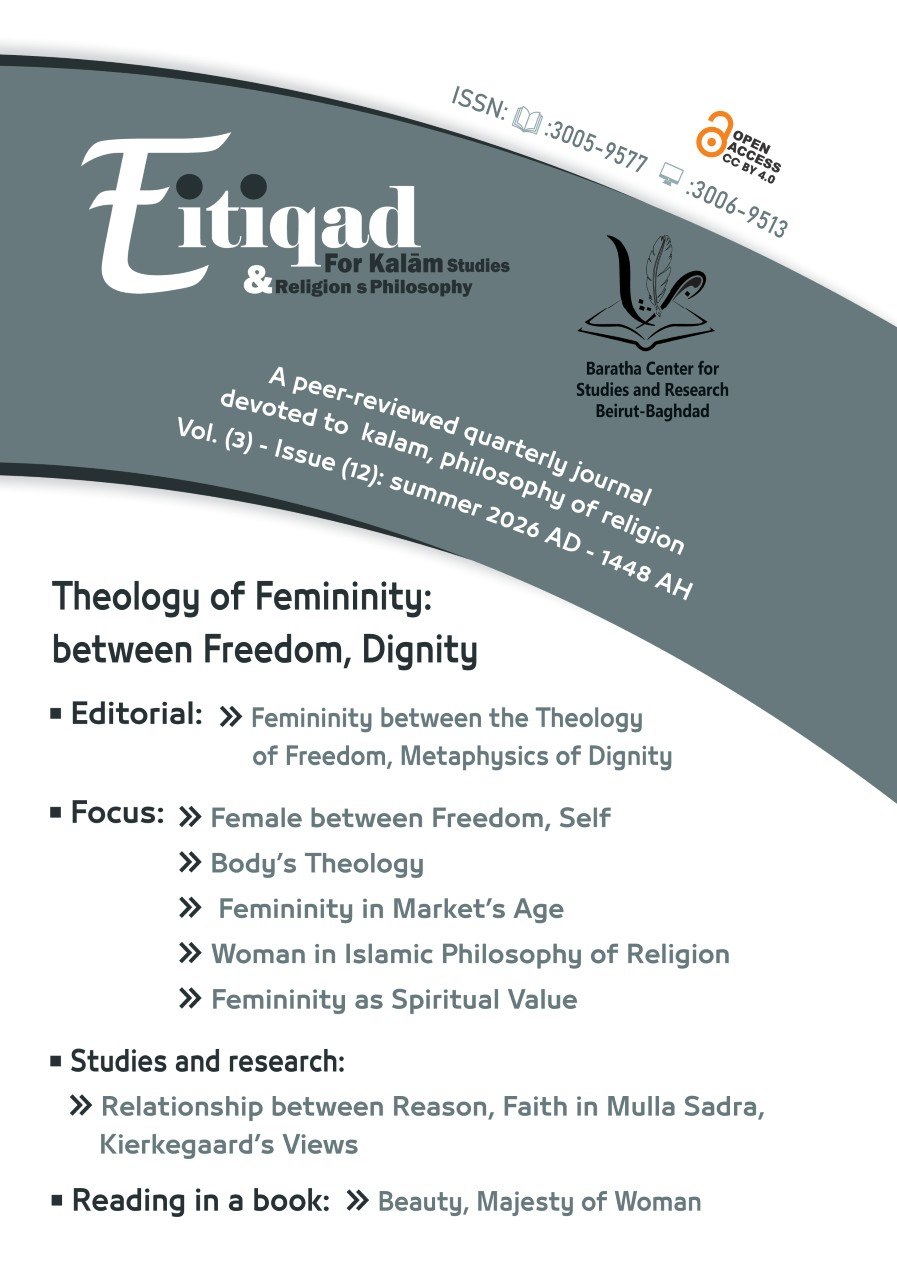
This issue of "Eitiqad" magazine opens the file on femininity as a foundational philosophical issue; it examines its Western manifestations in light of their metaphysical origins and contrasts them with the perspective established by Transcendent Wisdom. The conclusion drawn from this inquiry is that the image of woman in any civilization is the fruit of its metaphysics regarding existence, the soul, and value, and that reconstructing the question of femininity begins with re-examining these fundamental principles.
The comparison between the two systems reveals that the question of femininity is, at its core, a question about the human being. One’s stance toward woman and the body reveals one’s stance toward the soul, existence, and value; a vision that grounds femininity in the principle of dignity simultaneously grounds the entire human being in the principle of comprehensive divine honoring. Through this principle, Transcendent Wisdom reformulates the relationship between freedom and dignity, rendering them two facets of a single truth, and opens a horizon for contemporary Islamic thought to approach the questions of modernity from a foundational standpoint that transcends mere reception. Within this horizon, the issue of women finds its profound resolution through the recovery of the metaphysics of existence, a metaphysics that assigns to all beings their respective places and meanings. This foundational perspective opens a wide avenue for research converging on a single project: reconstructing the question of femininity upon solid philosophical ground and offering the Arab reader a vision that combines critical depth with foundational originality. Through this synthesis, we contribute to liberating consciousness from the captivity of imported concepts and to establishing an authentic perspective, rooted in its own civilizational origins, for addressing the deepest questions facing contemporary humanity.
We advocate here for a foundational approach that moves beyond merely observing a Western crisis from afar; instead, it seeks to interrogate a consciousness torn between the influences of both systems. Through this inquiry, we aim to construct a philosophical vision of femininity grounded in the metaphysics of existence and dignity, paving the way for a recovery of meaning in an era where the theology of freedom has come to dominate the image of the human being.
Building upon this intellectual horizon, this issue of "Eitiqad" magazine sets out to open a dialogue regarding these philosophical dilemmas.
A group of distinguished scholars has addressed various facets of the question of the " Theology of Femininity: between Freedom, Dignity", within the research papers and the articles of this issue. They are:
- The researcher (Prof. Ali Mohammad Alian Abdel-Razek Al-Khatib) (Egypt), his paper is titled: "Female Between Freedom, Self": A Critique of Western Feminist Philosophy from the Perspective of Philosophy of Religion".
- (Dr. Lisa Saeed Abu Zaid) (Egypt), with her paper: "Body's Theology: The Western Feminist Conception of Body, Identity".
- From Morocco, (Dr. Mohammad El-Mahifid) and the researcher (Nassima Saadi), with their paper: "Femininity in Market's Age: Review of the Transformation of Contemporary Feminism between Consumerism, Philosophy of Religion".
- Assist Prof. (Mazen Raslan Abu Diya) (Lebanon), his paper's title is: "Woman in Islamic Philosophy of Religion: Dignity, Not Sameness".
- The researcher (Al-Ameera Nimat Al-Ameer Ali Harfoush) (Lebanon), with her paper: "Femininity as Spiritual Value: Reflections on Philosophy of Complementarity between Male, Female."
In the "Studies and Research" section, (Dr. Mohammad Firas al-Halbawi) (Syria) translated the following paper from Persian: "Relationship between Reason, Faith in Mulla Sadra, Kierkegaard's Views", by (Dr. Mehdi Khademi) (Iran).
As for "Reviewing a Book", we have selected the book "Beauty, Majesty of Woman", presented by the writer (Mervat Ibrahim) (Lebanon).
We present this issue hoping it meets with the approval of our readers, and we earnestly hope they will share their valuable feedback with us.
Praise be to Allah, first and last.
Given the centrality of these concepts in shaping the feminist view of humanity, the researcher compares them with the philosophy of religion's conception of humanity as a spiritual and moral being, thus highlighting the points of convergence and divergence between the two frameworks. Therefore, the researcher employs a comparative, critical, analytical approach to examine these concepts and reveal their theoretical structure, within an analysis that balances the conceptual framework with its philosophical context.
The researcher concluded that Western feminism reformulated the concepts of freedom and identity through the conception of existential freedom and the social performance of gender, but this theoretical construction, despite its liberating tendencies, may, in some of its manifestations, involve reducing the human being to a single dimension, which opens the way for re-examining the concept of the human being and the limits of its philosophical definition.
This marginalization, in some instances, led to the emergence of a radical feminist revolution that made the body a defining element of identity. The study is primarily based on an analysis of "feminist phenomenology of the body" as a profound philosophical approach that restores the female body to its rightful place as a "lived experience." Drawing on philosophers such as Husserl, Heidegger, and Merleau-Ponty, the study ultimately affirms the general principle of the uniqueness of the female body. It concludes by proposing a conciliatory vision that seeks to transcend the apparent dichotomy between the religious perspective, which views the body as an instrument of worship and refinement, and the philosophical perspective, which treats it as a fundamental medium for engaging with and understanding the world.
The authors meticulously examine the historical development of feminist intellectual discourse through its three waves. The waves are beginning with the demands for equality and political and educational rights during the Enlightenment, then moving towards a critique of male dominance and the deconstruction of gender roles, culminating in contemporary postmodern thought that focuses on the concepts of difference and pluralism and rejects fixed and rigid identities.
The research analyzes the manifestations of contemporary fluid life, demonstrating how the market economy has successfully co-opted the liberating feminist discourse and transformed the essence of femininity into a marketing commodity and a fleeting advertising product, governed by the systems of fashion, digital advertising, and narcissism. It also delves into the linguistic and cultural roots that have historically perpetuated the subordination and inferiority of women. The research concludes by emphasizing the necessity of confronting the contemporary crisis of commodification by invoking the tenets of the philosophy of religion and reviving the logic of responsibility and moral duty towards the absolute and the universe, in order to restore the essential spiritual and ethical dimensions of lived human existence.
It began with a historical overview of the status of women in ancient civilizations. It then examined the reality of women in the contemporary West and the calls for women's liberation that arose in the nineteenth century.
The study then addressed the issue of women from the perspective of Islamic philosophy, beginning with the influence of Western feminist movements on thinkers in the Arab and Islamic worlds, and the impact of Western feminism on many of them. This study worked to demonstrate the status of women in Islam and their equality with men, based on the Quranic principle of justice, distinguishing between the principles of justice and equality. It then highlighted the value of women as a manifestation of divine beauty and majesty.
In conclusion, the study addressed objections raised by opponents of Islam regarding women, such as male guardianship and the issue of inheritance.
She begins with the premise that reducing femininity to these two orientations leads to the loss of its ethical and spiritual dimensions, which contradicts the understanding of its profound presence in human experience and its connection to beauty, love, nurturing, tranquility, and the balance of human existence.
Therefore, through a Qur'anic and philosophical-gnostic approach to the vision based on the integration of male and female, the article demonstrates that femininity is a spiritual and aesthetic value. She concludes that it is a dimension of human perfection, fulfilling humanity's and the universe's need for beauty, mercy, love, compassion, and kindness, especially in an era where modern and postmodern humanity is experiencing a crisis that can be understood as an imbalance in the scales of majesty and beauty, leading to a crisis of lost meaning and identity. She concludes that restoring femininity as a spiritual value can rebuild the image of a balanced human being, one in whom strength is united with compassion, reason with love, individuality with dignity, and difference with complementarity.
In this view, one cannot arrive at faith through rational thought and historical evidence alone. For Kierkegaard, the life of faith is fundamentally life lived within the framework of Christianity, and it is this Christian faith that preserves life in the face of all theoretical conflicts. Mulla Sadra, on the other hand, believed that faith, although a matter of the heart, is not limited to mystical revelation. Rather, knowledge of Allah, Almighty, through evidence and proof, that is, belief derived from theoretical reason, can also be considered faith of the heart. In other words, his efforts were based on establishing a foundation of reconciliation and harmony between reason and faith, or between mysticism and proof.
The author begins with the fundamental premise that the essence of humanity lies in the spirit, transcending masculinity and femininity, and that all levels of human perfection and divine closeness are related to this spiritual reality, not to physical characteristics. Through the interwoven application of three sources of knowledge, the Qur'an, mysticism, and rational proof, the book seeks to reconstruct the image of woman in Islamic thought, moving beyond interpretations that base moral distinctions on biological differences. It presents the general structure of the book and its main arguments, starting with its establishment of the concepts of beauty and majesty as manifestations of the divine names, passing through addressing the status of women in the Qur'an and their position in the path of human integration and divine succession, and reaching the mystical and philosophical arguments that the author adopts to deny any effect of masculinity and femininity on the reality of man and his perfection.



Comments