
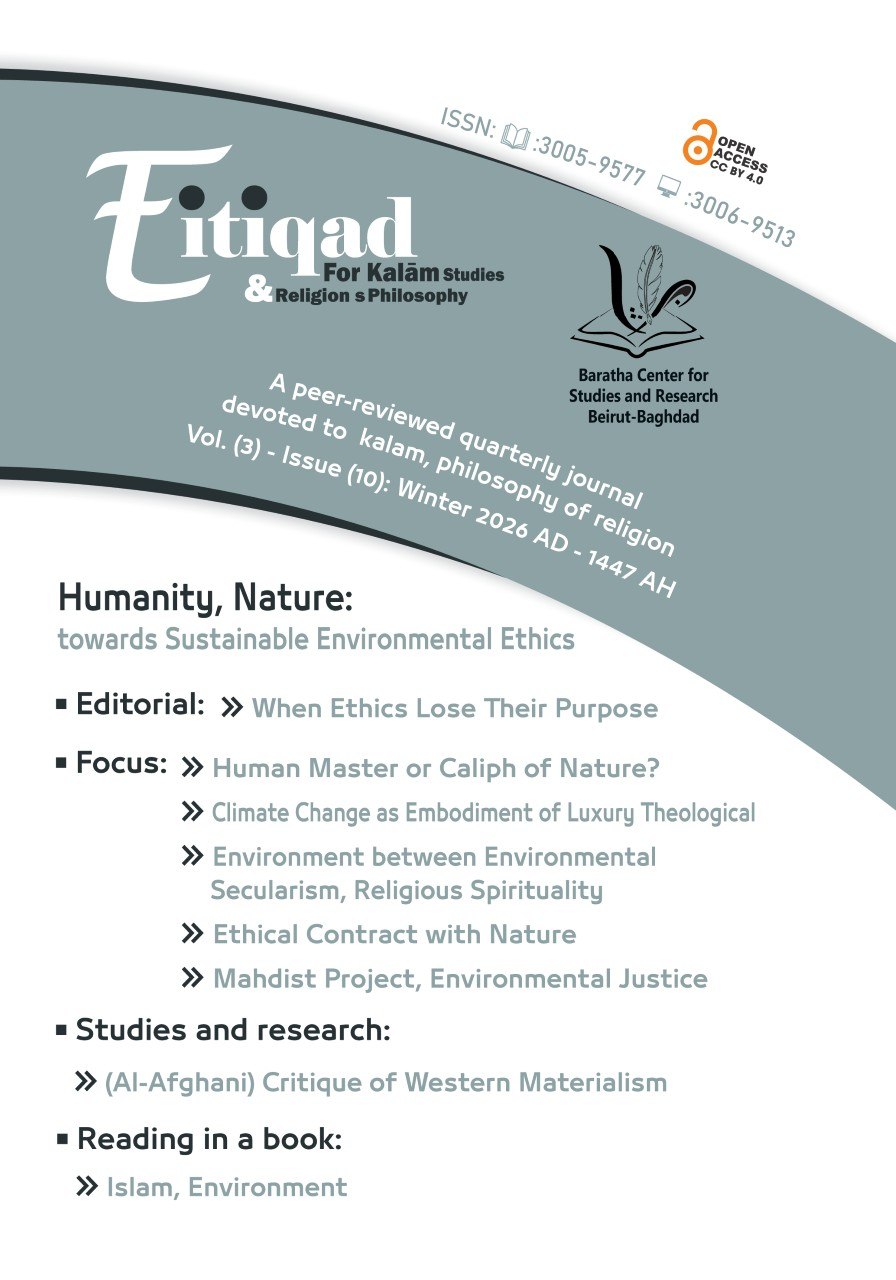
The place of humanity in this universe: Is man to be its master? Or its caliph and trustee? From this fundamental question, I have attempted to provide an answer by studying the issue through the lens of Western thinkers and contrasting their perspectives with an authentic monotheistic vision in light of the Islamic philosophy of caliphate. This philosophy has made humanity a caliph of nature, even a guardian responsible for preserving its sanctity and the divine order upon which it was created. According to this Islamic perspective, man is entrusted with a great responsibility, which is to cultivate and improve the earth, in contrast to the Western perspective, which has made man the master and owner of nature, free to do with it as he pleases based on his intellectual capabilities.
It examines how, under the dominance of the capitalist model, the human being has shifted from the position of stewardship based on cultivation and reform to one of consumption based on depletion and corruption. It argues that climate change is not merely a physical phenomenon but also reflects a spiritual and moral imbalance resulting from the dominance of luxury as an existential mode that transforms humans into consumers. It demonstrates that the environmental crisis represents the activation of universal and historical laws as an inevitable response to human transgression and the disruption of balance, in accordance with the Qur’anic view that links corruption to human behavior. The study also addresses the concept of the destruction of cities as a normative law that connects economic luxury with civilizational and cosmic collapse. It concludes by highlighting the limitations of technical solutions in light of the Jevons Paradox, which shows that increased efficiency may lead to greater consumption. In contrast, the study proposes an ethical alternative based on reviving the concepts of the “good life” and economy understood as moderation. This alternative draws inspiration from the model of Imam Ali bin Abi Talib, emphasizing the cultivation of the earth and the reinforcement of the principle of stewardship and environmental responsibility in order to protect human existence from destruction.
the future of humanity. Environmental problems today are no longer seen merely as disturbances in the natural system, but as the result of the way humans think and perceive the world. This research seeks to examine the environmental question through two competing perspectives that struggle over space and domination in today’s world. The first is a spiritual and religious vision, grounded in the idea of humanity’s ultimate purposes, viewing the human being as a bearer of a mission and a witness to civilization, within a framework consistent with the comprehensive nature of religion and its purposive objectives. In contrast, the research highlights the features of environmental secularism, which has accompanied a materialist view of the human being and existence. This perspective is centered on the self and considers the human being as solely responsible for their condition and their humanity. It aspires to offer a vision that takes into account the broader dimensions of religion, leading to solutions that address environmental problems resulting from ongoing violations of nature amid the growing spread of materialist tendencies based on consumer culture. This culture has not only violated the environment but also undermined human dignity, confining the human being to a purely consumptive dimension.
The research aims at clarifying the position of social contract philosophers on nature, starting from the concept of private property and the resulting social and political inequality in modern Western society. In this context, the research discusses the social contract theory, which examines the transition of humanity from a state of nature to a social and political state, and how proponents of this theory justified the political inequality that, in turn, led to economic class inequality, and the role of nature in reinforcing this inequality. It also addresses the concept of economic utility, treating nature and the environment merely as material resources contributing to wealth accumulation and creating relationships of exploitation and conflict due to the absence of a moral framework in dealing with the environment and nature. The researcher also aims at clarifying the differences between Islamic philosophy, through its major sources, and Western philosophy, particularly regarding spiritual matters that, in Islam, make the environment and nature a matter of faith and moral responsibility.
The modern humanity has lost its sacred relationship with nature, transforming it from a realm of balance and generosity into a resource for exploitation. The research begins by diagnosing environmental disturbances caused by human activities, such as pollution, global warming, and the loss of biodiversity, and argues that these are the result of an unsustainable development model based on greed and excessive consumption. It compares the reality of global environmental injustice, where poorer countries bear the burden of pollution produced by wealthier nations, with the Qur’anic and spiritual vision offered by the Mahdist project, which is presented as a divine model for restoring harmony between humanity and the universe.
The state of Imam Mahdi (may Allah hasten his reappearance) is not merely a political project, but a comprehensive cosmic environmental reform through which the balance of the earth is restored and environmental and social justice are achieved together. In this vision, nature becomes a partner in goodness rather than an object of exploitation. The research calls for renewing the spiritual relationship with the universe and drawing inspiration from the Mahdist vision to build a humane environmental consciousness that reforms the earth through the reform of the human being himself.
It elucidates the critiques leveled by this Islamic reformer against materialist doctrines, particularly emphasizing his deep concern for Islamic unity and his efforts to galvanize the Muslim world to transcend civilizational decline. Al-Afghani argued that such progress could only be achieved through a correct orientation toward science, rather than an adoption of destructive materialist and atheistic ideologies. He underscored the significance of religion as a civilizational foundation alongside science.
It is structured around several key themes: al-Afghani›s attitude toward Western civilization, whether critical or favorable; his critique of Western materialism and the reasons behind it; and the fundamental principles of materialist philosophy.
Furthermore, the study reviews atheistic materialism in antiquity, particularly as espoused by Democritus, Epicurus, and others, followed by an analysis of modern materialism, notably Darwin›s theory, which al-Afghani viewed as having detrimental human, scientific, and ethical implications. The research culminates in a detailed examination of al-Afghani›s critique of modern materialist thought.
The Earth, with all its natural components, requires human care and the protection of its resources. From both religious and scientific perspectives, the book discusses how humans should interact with the environment in accordance with Islamic teachings, which advocate for the Earth’s cultivation and preservation. It also highlights the dangers of pollution and environmental neglect resulting from the disregard of these principles. Within the chapters of his book, the author addresses humanity›s responsibility to utilize the Earth›s resources sustainably, emphasizing that humans are not merely creatures driven by their desires but are stewards of the Earth and all living beings. The book underscores the importance of adhering to divine commandments that safeguard the environment and maintain balance in life. Additionally, it stresses the necessity of seeking lawful means of sustenance and preserving the purity of the environment, the soul, and the body. The author concludes by affirming the importance of peaceful coexistence among religions and peoples as part of humanity›s responsibility to maintain societal harmony.
Rather, it has become a revealing sign of a deeper dysfunction in humanity’s conception of existence, and in the way that human beings have redefined their relationship with the Creator and the world around them. The manner, in which nature is perceived, is a direct extension of the doctrinal and epistemological framework that determines humanity’s place, the limits of his action, and the meaning of his presence in the universe. Modern intellectual trend, through its gradual separation of religion from the natural world, has contributed to reducing the environment to a purely technical issue, managed by the tools of science and economics and detached from the question of purpose. Through this separation, nature has been stripped of its ethical dimension, and the transcendent moral question has been marginalized in favor of a logic of management and control, rather than one of trust [al amanah] and responsibility. From this perspective, the environmental problem is approached as a crisis in doctrinal conception before it is a crisis of resources or policies. Rethinking the human nature relationship thus ultimately entails a critical reexamination of the epistemological and theological foundations that have governed our understanding of the world and paved the way for a mode of relationship severed from purpose.



Comments